I saw many other exhibitions but these were the ones that I ended up thinking about the most.
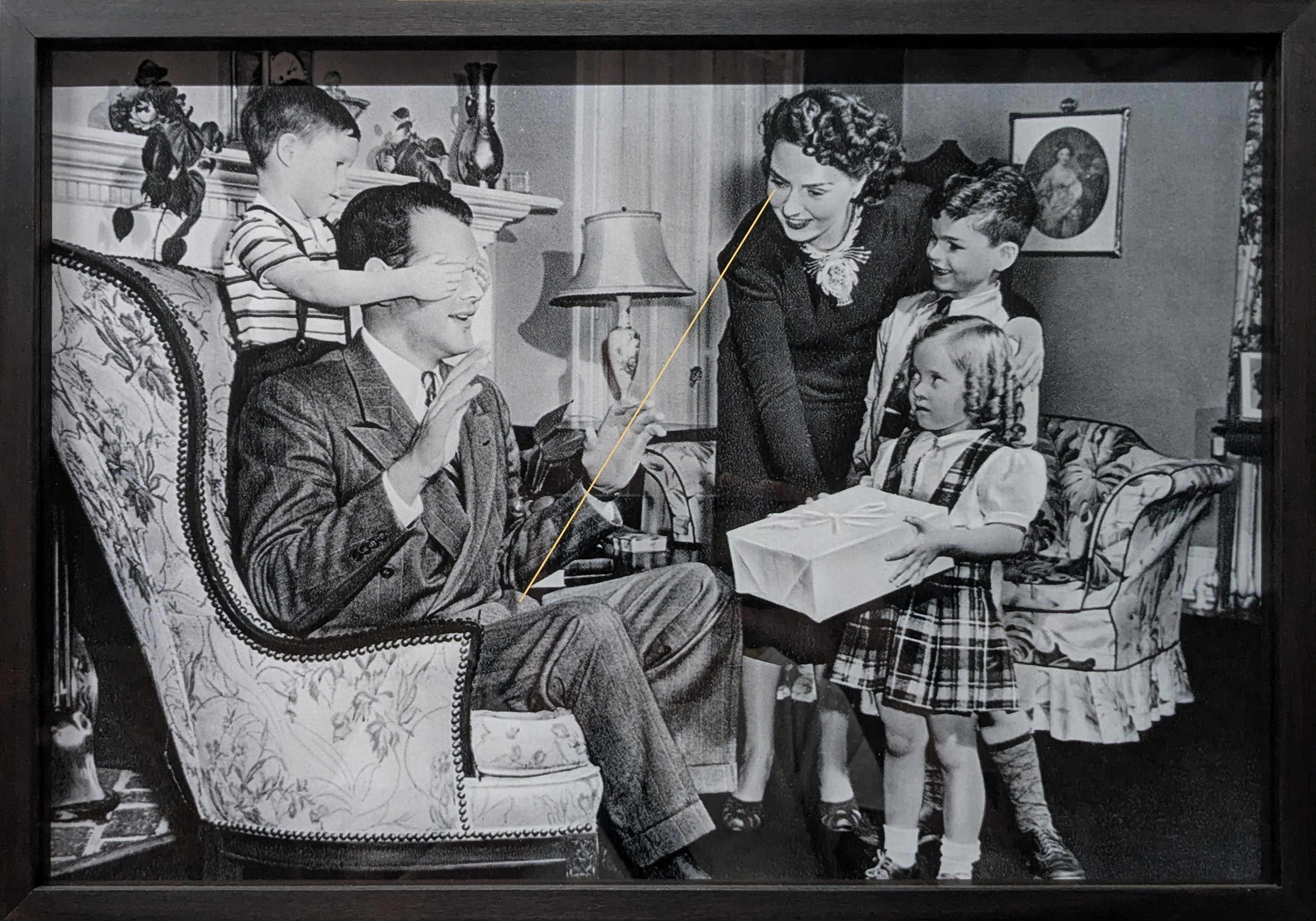
There were two shows that stood out to me were: Diana Markosian: The Cut Out, Father series, 2014-2024 and In Search of the Father by Camille Lévêque. These two could not be more different in terms of their approach and the images on show. Lévêque uses found images, advertisements, digital manipulation to unpack and present her ideas about the notion of the father as an archetype; while Markosian’s explores the specificity of the singular relationship with her own father.
Markosian’s exhibition blends documentary photographs, archive documents, film and peripheral but meaningful images into a narrative of loss and retrieval. The first image that confronts the visitor is a seeming family portrait, a toddler with it’s mother and father, but there is a violent edit in the first photograph that wrong foots the observer into expecting a story of patriarchal wrong doing as the father has been roughly cut out. What might be expected to be the beginnings of an abuse and flight story, turns out to be something quite different. At the age of 7 Markosian had been woken up by her mother in the middle of the night and told her to pack her things as the family was going on a trip from their Moscow home. What her mother had not said was that her father would not be accompanying them. He instead discovered his family had gone when he returned home to a bleak note left on the kitchen table.
The family did not just move to a different part of the city or even Russia itself, instead, Markosian found herself in California, a place so loaded with ideas of reinvention that it almost seems logical that Markosian’s mother cut her father’s image from family photographs and for 15 years his existence was perceived through this attempt at erasure. But the heart wants what it wants and eventually, after many years, she tracked him down to Armenia where they reconnected, not least through their individual relationships with photography. The images on show reflect this sense of dislocation, loss and a powerful need to regain something of that which has been so profoundly lost. At the end of the exhibition is a small table with sheets of paper and pencils and pens. The visitors are invited to write their own experiences of loss and searching, which I could not resist, though I had to wait my turn as there was one woman who was writing her story on multiple pieces of paper. This exhibition is a generator of words through work that is both intensely personal while still managing to connect across multiple streams of experience, across the geographic, emotional and cultural spaces that the subjects exist in between, Russia, Armenia and the USA.

The contrast couldn’t be more oblique between this and Lévêque’s work. To say that it is a mismash of styles, objects and images served up in a cow shed of a building might not sound particularly respectful or engaged but it really is a great body of work well suited to it’s space. Lévêque interrogates the idea of father across multiple types of family and relationship. Her acute eye manages to mash together and incredible array of archetypes without the need to come to a grand conclusion of what fatherhood actually means, instead acknowledging the constant shifts in meaning and behaviour from which that state emerges. This is the very opposite of the walled garden of Markison’s personal narrative, and yet it still contains the same ideas and questions. One through absence and the other that explores fatherhood as a cultural construct, asking: “What makes a good father? And a bad one? Is the father always a symbol of masculinity, strength and stability? What about fathers who are oppressive, authoritarian or abusive?” While both artists explore fatherhood, Markosian deals with the edifice of personal loss and the necessity of filling in the gaps that this loss requires. Whereas Lévêque examines the existing bond across multiple kinds of relationships.
In terms of story telling and image making without the intense and personal nature of Markison’s Father, I found Todd Hido at the Espace Van Gogh by far the most coherent and engaging. I’ve never come across this artist before. According to the blurb “Todd Hido is known for his atmospheric images of anonymous houses at night, urban landscapes, neglected interiors, and melancholic characters. His photographs are often described as cinematic, evoking an implicit narrative that allows for the viewer’s interpretation.” What touched me especially were the images that appeared to have been taken through the windscreen of a car. They reminded me of the journeys I took back and forth from Malvern while I visited my mother after her stroke. There was something in those images that connected with the loneliness I felt, returning to the place I had grown up, in knowing all of the time that I was on these journeys, that this was part of an ending. This stands to reason as much of the work I have been making over the past five years has been to investigate how photography can build those connections between people, to shift attention away from the spectacular surface of a photograph and run a thread into collective inner worlds and this is what Hido does in spades.
Hido’s show also included a series of vitrines which provided some important insight into his thinking around his work ranging from his first published book House Hunting, the contact sheets, loupe and other tools. Amongst the objects that had influenced his thinking was included Raymond Carver’s What We Talk bout When We Talk About Love. Carver is key writer in my research because of the similarities I found in the fractured relationships set in the lives of blue collar Americans; spaces where communication even in the closest human relationships can be fraught with misunderstanding and failures of empathy. Hido’s work provides film stills for Carver’s melancholy landscapes, he says: “I’ve always been drawn to Carver’s writing in particular such a plain-spoken but subtle way of describing the world and the relationships that people have with each other.” That Hido’s work has appeared on the covers of a series of Carver’s works is entirely appropriate and he rightly states, “it speaks to the circular give-and-take nature of influences.” But most curiously of all Carver was the first thing that came into my mind when I entered the room. Of course I could have unknowingly seen Hido’s work in a bookshop, but the exhibition itself felt like visiting the the outskirts of a Carver anytown.

It was quite a surprise to see the collection of items that Hido uses in his process. Part of me felt some relief to see many of the things I have on my untidy desk in the studio. I’ve found acknowledging the important things that shape my work quite difficult in the academic environment and much of the past three years has involved me struggling to find connections between much of the academic writing I have encountered and the work I am trying to make. Hido’s items are just as much citations as any clever quote from this or that theorist. Hido makes images, he refers to images across a wide range of sources, but more importantly, he refers to the things that he makes images with, from old photographs, chemistry and the hardware of photography, across digital and analogue.
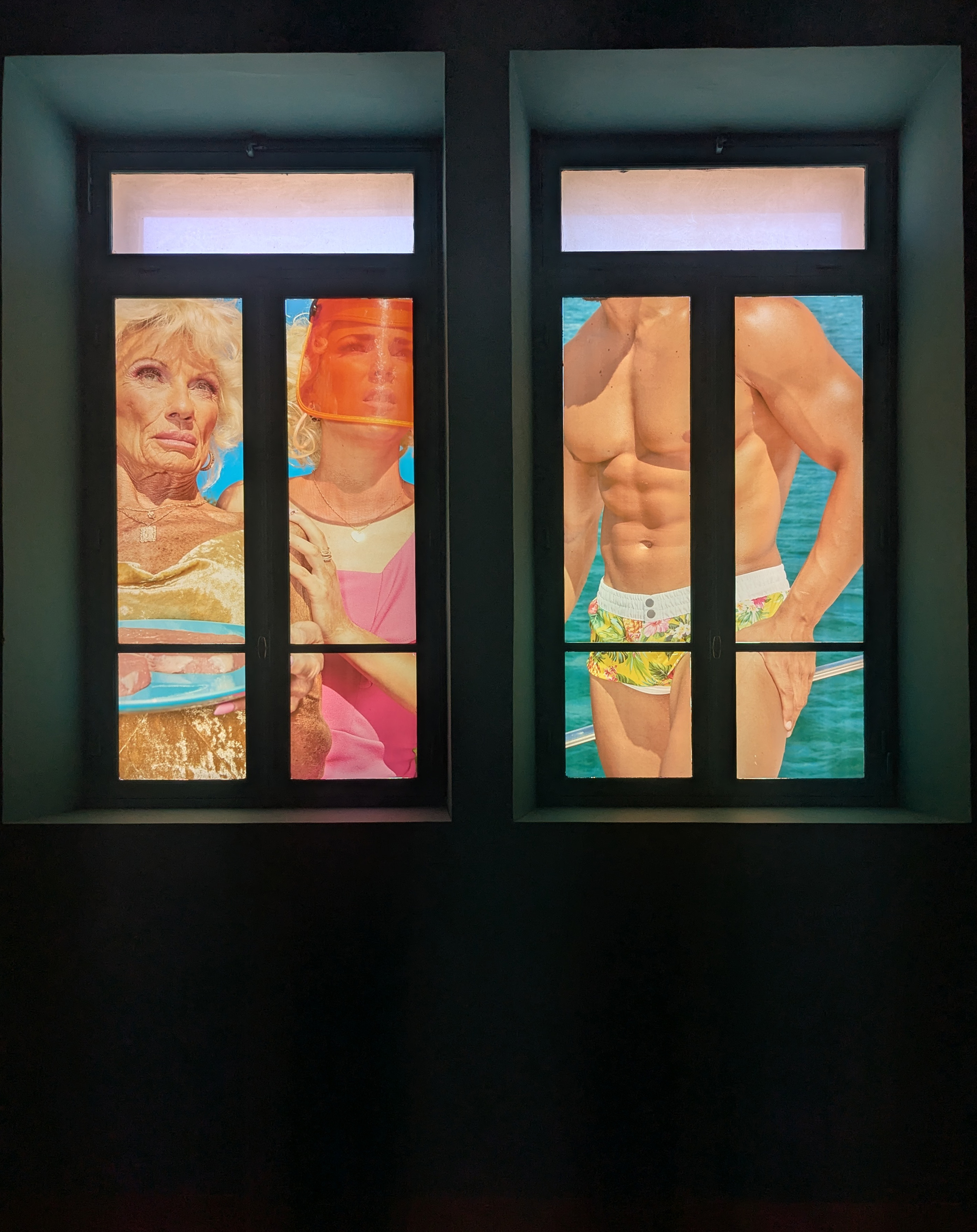
In contrast, Kourtney Roy’s The Tourist, on show at Ancien Collège Mistral, another artist whose work I did not know, had its power in it’s lack of explanation which had the effect of being like a series of stills from a particular kind of movie landscape. I was reminded of Boogie Nights, Tangerine, Striptease. The images reminded me of the kind of tacky glamour that made me quite excited the first time I ever saw an american motel with a neon sign through the window of the airport bus on my way into Portland Maine in 1989.
Nevertheless, there was somewhat of an elephant in the room as the official blurb that states that “Roy hits the holiday nail bang on the head. Research shows most people enjoy the anticipation and recollection of a holiday more than the actual experience, which is why the holiday snapshot is so important. It removes the disappointments and creates a rose-tinted memory of pleasures we didn’t have. Roy inverts the ritual by taking us into a setting of apparent glamour, which, in reality, is much closer to our own experience.”
Well, what adorns the walls (and window) in Ancien Collège Mistral has about as much in common with my experiences on holiday as I do with the kinds of people who think Dubai is a great place to go. I’m not knocking Dubai, I’m just saying I don’t understand the allure of tax free shopping in Uniqlo. Roy’s images are brash and bright and kinda seedy. I don’t have a problem with seedy. I rather like seedy because it reminds me of movies I’ve enjoyed, though wouldn’t chose to live in and certainly wouldn’t be paying to be bumping up against for my vacation. Ultimately I wasn’t sure what I was supposed to do with this work apart from compare it to Cindy Sherman, an artist who leaves me utterly cold. With this in mind, I will say, I like Roy’s work an awful lot more. There is a sense of a story being told, what the actual narrative is is very much up to the viewer. I started off thinking of Tangerine, but the darkness of the rooms led me in the direction of the motels in No Country for Old Men or Before the Devil Knows You’re Dead. That’s probably more me than Roy. Still it was a display of image making that is impressive. I really liked the hang in the darkened room and especially the transfer on the window.
In complete contrast, the works generated by Cine Clube Bandeirante (FCCB), an amateur photography club in São Paulo between 1939 and 1964 was well worth the effort spent trying to find La Mécanique Générale in the lee of the impressively unimpressive Luma building. On show was a resonant portrait of possibility and hubris catalogued in particular by Roberto Yoshida, Alice Brill and Tomaz Farkas.
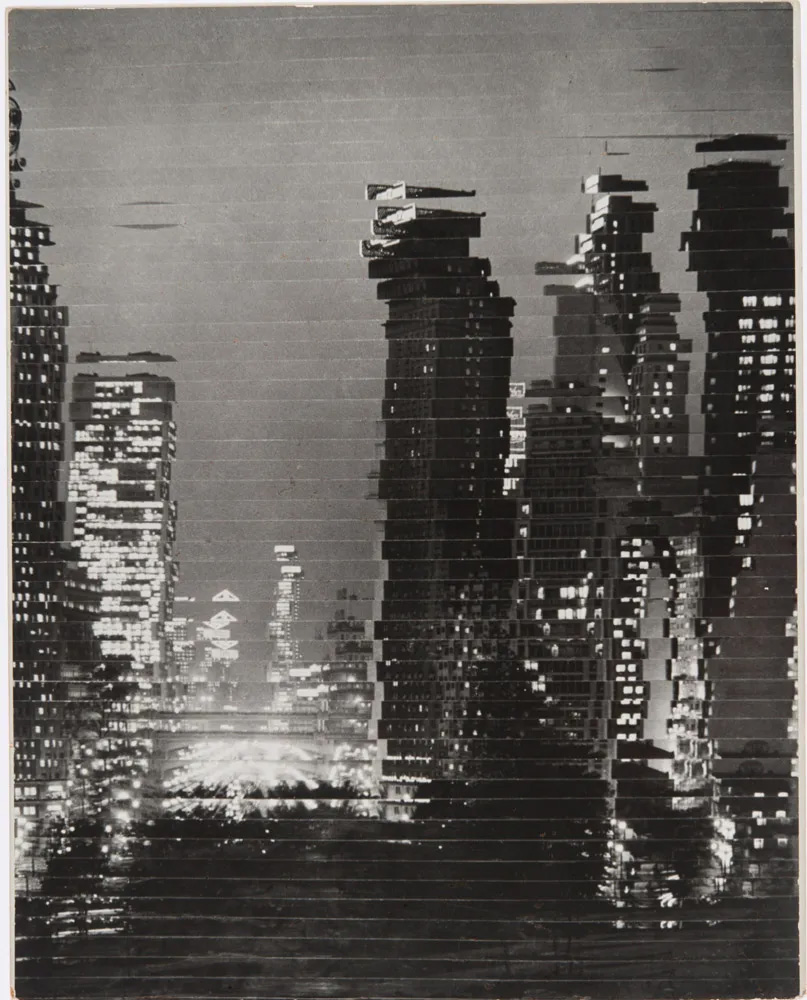
Yoshida had my kind of attitude towards photographs and cut two copies of the same photograph and then reassembled them into a single image, doubling the size of the already impressive buildings. These constructions were later rephotographed, changing the joins and gaps of the collaged image into something that has a great deal in common with glitchy digital content than the wet and dry, light and dark, chemical hum of the analogue darkroom. Of course it pissed people off when it was first shown, but it clearly did not deter Yoshida as the other beautiful works on show repeatedly attest to his talent and decidedly left field approach to analogue.
I rather foolishly didn’t take any photos of the other work on show, but another member of the club, Alice Brill, also produced work that wasn’t always greeted with open arms and some unstated reason, after less than a year’s membership, she was removed from the group. It is likely due to the tension between the group’s guidelines, which were intended to promote progress in Brazil, and her own interest in the actual lived experience of its citizens. From this show, it seems that to Brill, this cataloguing of progress made no sense without the social context that its foundations were dependent on. Brill’s work like that of Thomas Farkas and others refused to decouple the progress that the huge, modern cityscapes implied, from their colonial, slave trade foundations. What is interesting is that Brill, Farkas and others’ beautiful and compassionate photographs have a long tail and contain images that make it glaringly clear that the political, fiscal and social negligence of the Brazillian state has continued, while it’s modernist buildings are part of a movement now firmly in the rear view mirror.
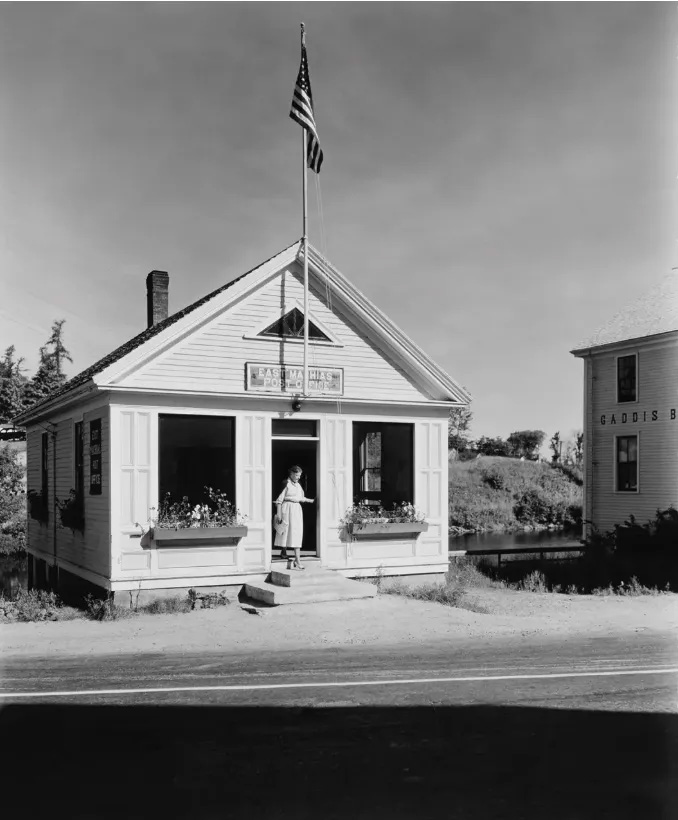
Finally, not everything that made me think, made me think entirely good things. There is an awful lot of meh on the walls in Arles. By far the most disappointing exhibition was Anna Fox and Karen Knorr making work in response to Berenice Abbott’s uncompleted project along route 1 from Fort Kent, Maine, at the Canadian border in the north to the Florida Keys in the south. Just as Abbott never completed her project, I really didn’t feel that Knorr and Fox had either; this despite making multiple journeys to the USA between 2017 and 2024. According to the blurb they made use of a suite of different kinds of image capture, from iPhones to large format cameras. Somehow, the show itself completely fails to bring this to the forefront; making the making a point of it, kind of pointless. This is entirely predictable, but this was an opportunity to engage with the importance of the modes of image making to the final result. I have no idea if that was a curatorial or artistic decision, but I think it is a clanger. I’m extra piqued because I didn’t know this is what they had done when I went to the exhibition, but as I’m pretty good at spotting method, it’s interesting that I completely failed to notice. The result, for me at least was the images themselves could have been taken by anybody from your auntie Barbara making the most of the incredible suite of features now found on a telephone, to Gordon Parks and his Graflex Speed Graphic; by which I mean there are items that look like snap shots and other items that look seriously considered. But mainly it was business as usual, people looking a certain way, doing slightly off-beat things, jarring commercial activity like a Gun Superstore, or flat on images of houses with Trump memorabilia, all framed in ways so ambiguous that it’s only really the scale that hints at the presence of a suite of cameras.
The stated aim was to show a cross section of society along the route and they certainly did that. The question remained though, why bother? There was for me no thread that ran through the exhibition beyond confirming my suspicion that the USA is not a safe country for me to visit. Perhaps there is already too much information in my own head about these kinds of images for me to be able to see beyond their surface. More likely, unlike Todd Hido’s work, this is so tightly wound around a topic so familiar as there to be no space for any ambiguity to beckon me into casting more than a cursory glance on each image. In the Hido exhibition, I kept looping back to some of the images, going back to the vitrines as these things spoke to each other. In Roy’s I went back and forth between the images in order to cut the movie it made in my head. In the Brazillian Modernism, I was just knocked over by the beauty and unexpectedness of the emergence of the kind of moderness my school books were filled with, that now look so old fashioned. While it’s true, I did revisit some of the images, to see if there was something more, but all I encountered was a feeling of disappointment with the sheer predictability of what I was in front of. Maybe that was the point, but I doubt it, and came away with the feeling that the female experience in the american dream is just as outdated a subject as the american dream now seems itself.
I would like to thank Ingrid Guyon and her father and mother for the invitation to the festival.
All quotes from the specific exhibitions at Arles