The late vegetarian playwright George Bernard Shaw used to say he’d like to dig up Shakespeare and throw stones at him. It’s a completely unreasonable position to take in so many ways, but not entirely. Shaw got irritated with some of the weaknesses in Shakespeare’s work that tend to be overlooked because he was ‘the bard’. I get this, I spent three years as an undergraduate reading Shakespeare’s plays and poems and for the most part I think he was an awful lot better than Shaw, but then there is also Cymbeline, Loves Labour’s Lost and Henry VIII. Shaw later clarified his position saying that on reflection his view of Shakespeare had been coloured by Victorian messing with the texts because the Victorians didn’t like being challenged. I’m bringing Shaw up here because I sometimes feel the way he felt about Shakespeare, about Henri Cartier-Bresson.
I would imagine that most people who know the name Henri Cartier-Bresson will also be familiar with the term the decisive moment. This is a term Cartier-Bresson appears to have coined in his first photobook of what we now call street photography. The book original title in French is “à la sauvette”, which best translates as ‘on the sly’, which from my own experience, skittering about with an OM1, trying not to be noticed while I snapped away, is probably a much better term. It’s not that Cartier Bresson didn’t think of there being a decisive moment because he considered that there is such a thing as the optimal point at which to press the shutter in this translation of a section of his original preface:
Sometimes it happens that you stall, delay, wait for something to happen. Sometimes you have the feeling that here are all the makings of a picture – except for just one thing that seems to be missing. But what one thing? Perhaps someone suddenly walks into your range of view. You follow his progress through the viewfinder. You wait and wait, and then finally you press the button – and you depart with the feeling (though you don’t know why) that you’ve really got something. Later, to substantiate this, you can take a print of this picture, trace it on the geometric figures which come up under analysis, and you’ll observe that, if the shutter was released at the decisive moment, you have instinctively fixed a geometric pattern without which the photograph would have been both formless and lifeless.
Henri Cartier-Bresson
Snarky critics, artists and PhD candidates like to point out that Cartier-Bresson was sensible and often took multiple frames, or bracketed, so it’s maybe the decisive moment in a bouquet of moments. The point is, the term is attached to Cartier-Bresson and his work and I feel that it does him a disservice and also makes it difficult to talk about photography, especially when it is central to an artistic practice.
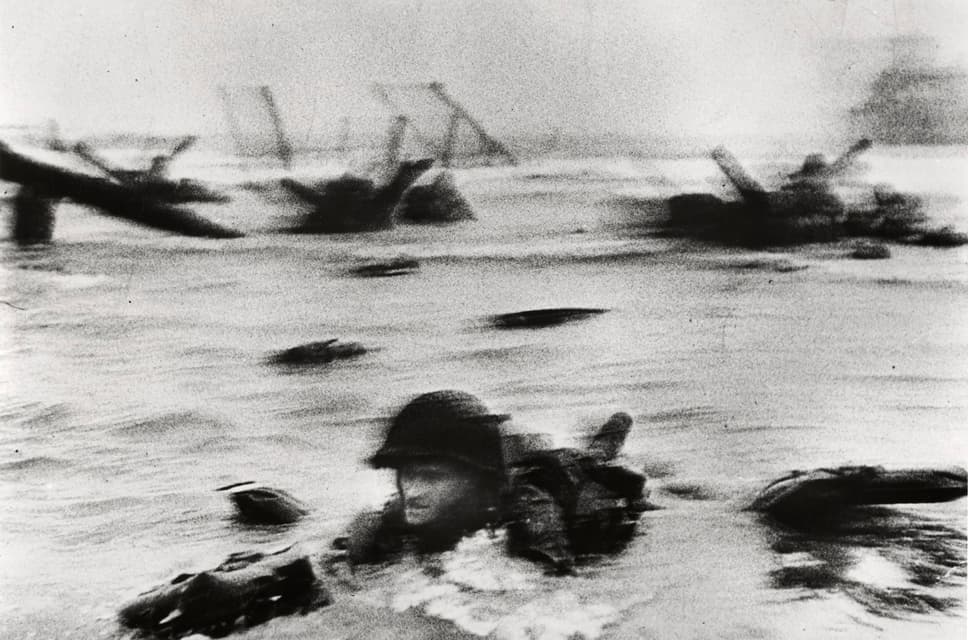
For example, in the paragraph from the preface, Cartier-Bresson goes into some detail about the other processes that need to be undertaken in order to find out if he really had captured something special. And any one of those processes could also have interrupted or even destroyed the images on the film. The blurry, jittery, smudgy images that made Capa’s D Day photographs so iconic, so fixed in our ideas of the horror and chaos of that day, work because they are just a handful of frames and whatever the mythology that has accrued around how they came about, they stand as really good photographs of something terrible unfolding. In this case, it’s besides the point if they are what we might normally think of as a ‘good’ photograph. Cartier-Bresson’s work is consistently sharp, clear, precise and candid. What I am less convinced of is if this work is really all that interesting now everybody can capture something similar on their camera roll. And if that is the case, what is it that is holding Cartier-Bresson in place in the canon?
My research is concerned with narrative and how process can affect, shape and direct it. What I’m not that interested in is shaping the content of the narrative into something finished and coherent. As I draw closer to the end of my research I am realising that what interests me is connecting the threads between the subject of a photograph and the viewer and hoping that this connection sparks something in the viewer that goes beyond being a 2d human.
I like hidden narratives that need excavating, but this doesn’t mean it see it as imperative to inspect each and every element of a narrative in order to complete it like a quest. Of all the things that pass through my mind when I am looking at the work of Cartier-Bresson, the underlying story of the subject isn’t one of them; so he is absolutely not a photographer I head for when I’m considering narrative. I find him very similar to Vivien Mair in the way that some of the captures are so beautiful, so unique, so compositionally arresting that it is impossible not to look at the image and wish that I’d been in that place, at that time, with my camera because the joy of seeing such an image emerge in the developer, or returned from the lab must have been incredible. But, that’s me, I get the main buzz about a photograph at the point where apparatus, substrate, chemistry and light converge. This is very different to the ways in which I first engaged with photographs, where I would get excited when an envelope of pictures was returned from the lab and I would get a second look at a party, a wedding, the anticipation and the realisation were part and parcel of that experience. I am aware that both Mair and Cartier-Bresson at some points in their careers had access to a darkrooms2, but for the most part both relied on other people to develop and print their work, and in Cartier-Bresson’s case, he seems to have actively disliked the messy stinky process of putting an image on paper3.
Constant new discoveries in chemistry and optics are widening considerably our field of action. It is up to us to apply them to our technique, to improve ourselves, but there is a whole group of fetishes which have developed on the subject of technique. Technique is important only insofar as you must master it in order to communicate what you see... The camera for us is a tool, not a pretty mechanical toy. In the precise functioning of the mechanical object perhaps there is an unconscious compensation for the anxieties and uncertainties of daily endeavour. In any case, people think far too much about techniques and not enough about seeing. 4
I don’t agree with Cartier-Bresson. I don’t think you need a camera in order to see or capture a decisive moment. I also don’t think he the camera is the thing that can make someone observant. This not least because I reckon Andrea del Sarto captured a decisive moment over 500 years ago and he did it with paint and canvas.
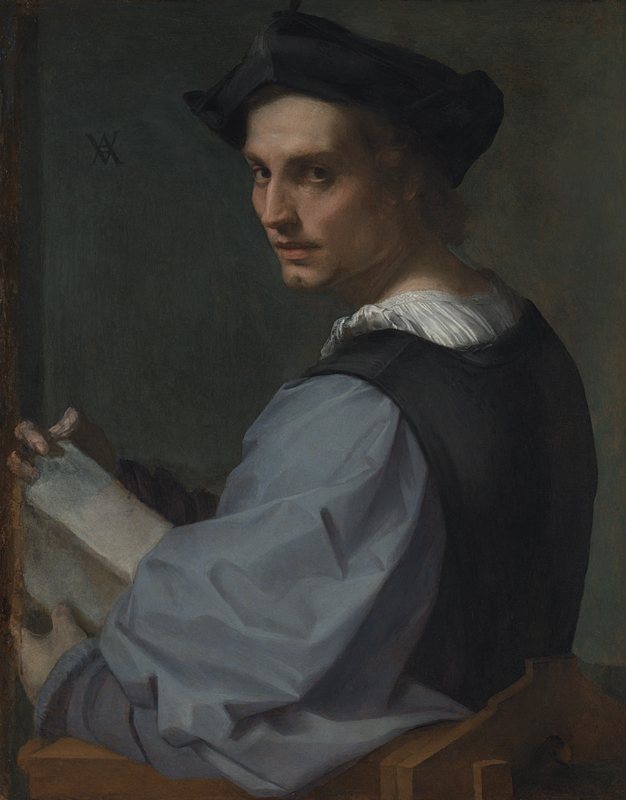
I clearly remember the first time I saw this painting in the National Gallery in autumn 1987, it’s not a small painting, it wasn’t the most obvious one in the room with its muted blues, greys and browns. But despite this, it was the most magnetic and I was quite surprised that the gaze actually made me feel a little uncomfortable. This portrait seems to have captured some fleeting muscle movement; by which I mean, despite the materials and processes used in the production, pigment, linseed oil, stretched canvas and so on, it doesn’t look entirely like a formal portrait made in a studio, practised and posed. To me, it looks almost exactly as if someone with a camera has snuk up on their boyfriend/friend/brother/mortal enemy. This sitter appears to be looking at someone who is pulling on a thread that reaches beneath their skin which may be why del Sarto used the bunched up shirt beneath the waist coat to imply a shift in position, a lack of readiness that traps the sitter between facing away and facing the viewer. This is not an easy pose to hold, I wonder about the sketches it took to bracket that look.
I used this as a template when made this I photograph a few years ago. I showed Marcelo the painting and asked him to try and look through the lens with the same kind of energy. It was probably between 1/8 and 1/15th of a second, hand held on Kodak Ektar.

This image is, amongst other factors, the confluence of my practice, of my understanding of the light in the room, the film stock I was using, the square format of the Hasselblad, Marcelo’s professional experience as a fashion model and the del Sarto portrait. I showed him the painting and we talked about what the subject might have been thinking. I have no idea what was actually going through Marcelo’s mind and I don’t really care, but his expression in this frame is a decision. This image is constructed, it has narrative and purpose. In response to del Sarto’s portrait of a young man, and the narrative is intended to make the viewer want to know the subject’s story, not to tell it.
Notes
1 Cartier-Bresson, H, The Decisive Moment: Photography by Henri Cartier-Bresson, Simon and Schuster 1952
2 https://www.lensculture.com/articles/vivian-maier-vivian-maier-street-photographer-revelation
3 http://www.nytimes.com/2004/08/04/arts/04CND-CARTIER.html
4 Cartier-Bresson op cit.